In the fall of 1931, President Herbert Hoover had two strikes against him. The nation was in the throes of the Great Depression and alcoholic beverages were outlawed under Prohibition. To many Americans, Hoover wasn’t doing enough to improve the economy and was an obstacle to ending the ban on booze.
 When Hoover attended Game 3 of the 1931 World Series between the Cardinals and Athletics at Philadelphia, spectators in the bleachers voiced their displeasure with him, booing when he arrived and when he departed.
The reaction was significant because it demonstrated how unpopular Hoover became. Three years earlier, when elected president in 1928, Hoover got 65.2 percent of the votes in Pennsylvania. Now he was being jeered there.
Orphan to president
Born in West Branch, Iowa, Hoover was 6 when his father, Jessie, a blacksmith and farm equipment salesman, suffered a heart attack and died. Three years later, the boy’s mother, Huldah, developed pneumonia and also died. Hoover moved in with an uncle, Dr. John Minthorn, in Oregon, according to University of Kentucky associate history professor David E. Hamilton.
Hoover eventually enrolled at Stanford and majored in geology. (He married the school’s lone woman geology major.) Hoover briefly was a shortstop for the Stanford baseball team, according to the White House Historical Association. Then he became a student manager for the university’s baseball and football teams.
Hoover used his geology degree to make a fortunate in mining.
The outbreak of World War I brought Hoover into public service. He organized the Committee for the Relief of Belgium, raising millions of dollars for food and medicine to help war-stricken Belgians. In 1917, President Woodrow Wilson, a Democrat, chose Hoover to run the U.S. Food Administration, leading the effort to feed America’s European allies. After the war, Hoover headed the European Relief and Rehabilitation Administration. “In this capacity, Hoover channeled 34 million tons of American food, clothing and supplies to Europe, aiding people in 20 nations,” according to historian David E. Hamilton.
Hoover then served as secretary of commerce in the administrations of President Warren Harding and President Calvin Coolidge.
In 1928, Hoover was the Republican nominee in the presidential race against Democrat Al Smith. A campaign circular proclaimed Hoover would put “a chicken in every pot and a car in every garage,” according to historian David E. Hamilton.
At a September 1928 game in Washington between the Yankees and Senators, a photographer asked Hoover to pose with Babe Ruth. Hoover agreed, but Ruth didn’t. According to the New York Times, Ruth barked, “I’m for Al Smith.”
Not even an endorsement from the popular Bambino, though, could save Smith. With the economy booming in the Roaring Twenties of the business-friendly Coolidge administration, voters overwhelmingly opted to keep a Republican in the White House. Hoover won, with 444 electoral votes to 87 for Smith.
Dark days
Hoover took in plenty of big-league baseball games as president. He threw the ceremonial first pitch on Opening Day at Griffith Stadium in Washington during each of his four years in office. Video
Hoover also became a good-luck charm for the Philadelphia Athletics. From October 1929 to July 1931, he attended five of their games and the A’s won every time. The first of those was the finale of the 1929 World Series at Philadelphia on Oct. 14. When he entered Shibe Park to see the Cubs and A’s, Hoover “received a rousing welcome … from the thousands of fans who crowded every corner of the stands,” the New York Times reported. Boxscore
Ten days later, the stock market crashed and the Great Depression followed.
In 1930, Babe Ruth sought an $80,000 salary from the Yankees. Told that was more than Hoover made, Ruth responded, “I had a better year than he did.”
According to the Encyclopedia Britannica website, “Hoover’s reputation as a humanitarian _ earned during and after World War I as he rescued millions of Europeans from starvation _ faded from public consciousness when his administration proved unable to alleviate widespread joblessness, homelessness and hunger in his own country during the early years of the Great Depression.”
In his book, “My Florida,” Ernie Lyons, editor of The Stuart (Fla.) News, told the story of the “Hoover chicken” to illustrate the hardships residents of his community experienced.
“Back in the closing days of the Hoover administration, the promise of ‘a chicken in every pot’ had fallen through so dismally that anything edible in the countryside was substituted,” Lyons wrote. “In our part of South Florida, the gopher tortoise, an edible land turtle, was a life-saver for genuinely poverty stricken families … The Hoover chicken resided _ and still does _ in long tunnels slanted back into the spruce terrain of high, dry backwoods sections … During the Great Depression, the gopher tortoise hunter was a common sight in our woods as he prowled with a long, limber hook-pole over his shoulder, carrying a croaker sack and a shovel. When he found a gopher tortoise hole, he would push the pole down the tunnel and fiddle around, sometimes for half an hour, to hook the tortoise by the carapace and haul it out.”
The consequences of the economic collapse took its toll on Hoover. In the book “The Powers That Be,” journalist David Halberstam wrote, “As the Depression grew worse, Hoover turned inward. He had been unable to deal with the terrifying turn of events. Immobilized politically by his fate, he grew hostile and petulant.”
Hoover attended Game 1 of the 1930 World Series between the Cardinals and Athletics at Philadelphia, but unlike the reception he got the year before, “it was a very quiet, undemonstrative crowd and … the entry of (Hoover) drew only a modest cheer,” The Sporting News reported. Boxscore
Philly flop
By 1931, the Great Depression had reached “panic proportions,” according to the book “Baseball: The Presidents’ Game” by William B. Mead and Paul Dickson. “More than 2,200 banks had failed in 1931 alone, stripping families of their savings. Unemployment was continuing to rise … Hoover was now a president besieged, his name part of the vocabulary of the Depression: shantytowns of the homeless were known as Hoovervilles.”
Hoover had committed to attend Game 3 of the 1931 World Series between the Cardinals and A’s at Philadelphia on Oct. 5, but he wasn’t in the mood. On Oct. 4 in Washington, he’d met late into the night with banking officials, but made no progress. In his memoirs, Hoover recalled, “I returned to the White House after midnight more depressed than ever before.”
Traveling to Philadelphia in the morning for a ballgame had no appeal. “Although I like baseball,” Hoover wrote in his memoirs, “I kept this engagement only because I felt my presence at a sporting event might be a gesture of reassurance to a country suffering from a severe attack of jitters.”
A few minutes before the start of the game, Hoover and his entourage were escorted onto the playing field at Shibe Park through a private entrance and proceeded through a lane of policemen to their box seats.
Light applause from the grandstand greeted his arrival, but then boos came from the bleachers. “Out of the first spontaneous applause there comes an unmistakable note of derision and this note is taken up by more timid souls until ultimately it becomes a vigorous full-rounded melody of disparagement,” Joe Williams of the New York World-Telegram reported.
As Paul Gallico of the New York Daily News put it, Hoover “entered the ballpark to the low, snarling rumble of popular disapproval.”
In “Baseball: The Presidents’ Game,” authors Mead and Dickson noted, “The booing became almost a roar.” Joe Williams wrote, “The catcalls and boos continue until Hoover and his party have taken their seats.”
Then a chant came from the bleacher sections: “We want beer.”
Prohibition was in its 12th year. It started in 1919 through an act of Congress, which overrode President Wilson’s veto. By 1931, many wanted the alcohol ban to end. Hoover, who supported Prohibition, was unmoved by the calls from Shibe Park spectators. “He sat there with his hands folded across his tum-tum and smiled, as if to reply, ‘Try and get it,’ ” Joe Williams noted.
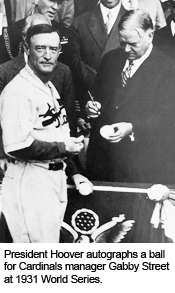
Hoover was seated just as the Cardinals were finishing fielding practice. According to the Philadelphia Inquirer, Cardinals owner Sam Breadon, manager Gabby Street and equipment manager Butch Yatkeman went over to greet him. Street asked Hoover to autograph a baseball. Yatkeman brought three balls to autograph.
Then it was time for Hoover to throw the ceremonial first pitch from his box seat to A’s catcher Mickey Cochrane on the field. “He took a straight Republican windup, but he threw like a Bolshevik,” John Kieran wrote in the New York Times. “The ball went yards over Mickey Cochrane’s head and fell among four umpires.”
It was that kind of a day for Hoover. He didn’t even provide his customary good luck for the A’s. Burleigh Grimes held the A’s hitless for the first seven innings. Boxscore
With the Cardinals ahead, 4-0, after eight, Hoover decided to leave. A ballpark announcer bellowed over the loudspeakers, “Silence, please!” and requested that all spectators remain in their seats until Hoover and his entourage exited.
“This was the signal for another rousing shower of razzberries,” Joe Williams reported. Paul Gallico described the booing as “determined and violent.”
“A polite pattering of applause” from the grandstand was countered by “an undercurrent of growling” from other sections of the ballpark, Gallico observed.
In his memoirs, Hoover recalled, “I left the ballpark with the chant of the crowd ringing in my ears: ‘We want beer!’ ”
A year later, Franklin D. Roosevelt (472 electoral votes) thumped Hoover (59 votes) in the 1932 presidential election. The only large state to go for Hoover was Pennsylvania, with its 36 electoral votes.