
In baseball, being right can get you fired. It happened to Alvin Dark.
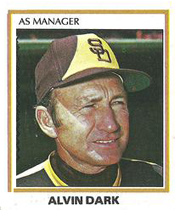 When the Padres opened spring training camp in 1978, Dark made a daring decision. The manager named Ozzie Smith the starting shortstop.
Smith, 23, had no big-league experience. He didn’t have much minor-league experience either. He’d spent part of a season at Walla Walla, and a couple of months in the Arizona Instructional League. Dark saw him there.
A shortstop himself (with the Cardinals and others) before becoming a manager, Dark determined Smith was ready to make the leap from Class A to the majors.
“Alvin Dark took a chance on a skinny kid from south-central Los Angeles, and he believed that I could one day be one of the best shortstops that ever played the game,” Smith recalled to Cardinals Yearbook in 2002.
Dark’s bold move turned out to be a smart one. Smith did the job, taking the first impressive steps toward a Hall of Fame career, but Dark wasn’t there to witness the rookie’s rise. In shaking up the infield, Dark shook up Padres management and players. He was fired before spring training ended.
Under development
When Ozzie was 6, his father, Clovis, a truck driver, and mother, Marvella, moved the family from Mobile, Ala., to the Watts section of Los Angeles. In August 1965, “we had to sleep on the floor because of the looting, rioting and sniping,” Smith recalled to Vahe Gregorian of the St. Louis Post-Dispatch.
Clovis left the family and Marvella worked seven days a week in a nursing home.
At Locke High School, Smith was a teammate of another future Baseball Hall of Famer, Eddie Murray. The Orioles took Murray in the 1973 amateur draft. No clubs sought Smith. He enrolled at California Polytechnic State University in San Luis Obispo and made the baseball squad as a walk-on.
“I never taught Ozzie anything about playing defense,” Cal Poly coach Berdy Harr told the Chula Vista Star-News. “He already knew what that was all about when he came to us. He had a sense of timing, rhythm, I had never seen.”
As Smith later recalled to the Philadelphia Daily News, “I never had trouble catching the ball, even in Little League. I’ve always been able to throw it and I’ve always had a knack for making the right play.”
What Smith needed help with was controlling his temper. “I had a short fuse in high school,” he told the San Luis Obispo Tribune.
He also had to become a better hitter. Smith batted .158 as a college freshman; .230 his sophomore season. Harr suggested he try switch-hitting.
In the summer of 1975, Smith played semipro baseball in Clarinda, Iowa. “Most people would have no idea of how intimidating and stressful it could be for a young black player to move into an all-white rural community in the Midwest,” Smith said in his Hall of Fame induction speech.
The townsfolk embraced him, however, and Smith thrived, improving his hitting. He was a complete player when he returned to Cal Poly for his junior year, batting .308. Detroit took Smith in the seventh round of the 1976 amateur draft, but he didn’t like the Tigers’ offer and opted to stay in school.
As a senior, Smith hit .307, stole 44 bases for the second season in a row and dazzled on defense. “In all my years of coaching, he is the one player I would most rather depend upon in a clutch situation whether it was fielding, making a throw or executing offensively,” Harr told the San Luis Obispo Tribune. “It has been a pleasure watching him mature as a person and as a player.”
Shortstop sensation
The Padres signed Smith after taking him in the fourth round of the 1977 draft. Sent to Walla Walla, he produced a .391 on-base percentage in 68 games and swiped 30 bases.
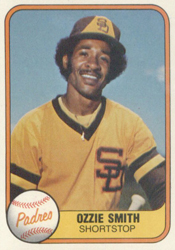 In the fall, the Padres put Smith on their Arizona Instructional League team. Hall of Fame second baseman Billy Herman, a Padres minor-league hitting instructor, saw him and was impressed. Then Alvin Dark arrived.
Dark knew what it took to play shortstop. He’d been a good one, a three-time all-star and recipient of the 1948 Rookie of the Year Award. Dark played in World Series for the Braves (1948) and Giants (1951, 1954). The Cardinals traded Red Schoendienst for him in 1956.
As a manager, Dark won a National League pennant (1962 Giants) and a World Series title (1974 Athletics). The Padres hired him in May 1977, replacing John McNamara.
It didn’t take long for Dark to determine the Padres needed an infield upgrade. Their second baseman, Mike Champion, batted .229, third baseman Tucker Ashford had no power (three home runs) and shortstop Bill Almon made 41 errors, hit two homers and struck out 114 times. Overall, the 1977 Padres made a league-leading 189 errors, including 46 at shortstop.
Dark came to the 1977 Arizona Instructional League to see another player, but the one who got his attention was Ozzie Smith. The shortstop made two jaw-dropping fielding plays in one game. “They were the kind of plays you said, ‘I don’t believe this,’ ” Dark recalled to the Post-Dispatch. “To have the coordination and the rhythm and the timing all in one body like Ozzie had, that was very unusual.”
Ready or not
At spring training in February 1978, Dark declared Smith the shortstop and shifted Bill Almon to second base. Derrel Thomas, acquired from the Giants, took over at third and Gene Richards went from left field to first. The reconstructed infield was “a gamble that alarmed the front office,” The Sporting News reported.
Almon, Richards and Thomas were playing out of position. When the four starting infielders didn’t mesh in early spring training games, the Padres reacted with panic rather than patience. “We were getting a lot of feedback from players,” Padres owner Ray Kroc told The Sporting News.
On March 21, 1978, Dark was fired. The infield experiment “contributed to his banishment,” The Sporting News reported.
Additionally, “Alvin wasn’t communicating with the players, the front office or the media,” Kroc said to The Sporting News. “He wasn’t willing to delegate authority to his coaches … Alvin had a tendency to overmanage. He wanted to be the pitching coach, the batting coach, the infield coach.”
Padres player Gene Tenace told the magazine Dark “put in so many trick plays and had so many signs that everyone was uptight. There were too many things to worry about. I like Alvin … but the team is more relaxed now that he’s gone.”
In his book “When In Doubt, Fire The Manager,” Dark said, “I felt it was disgraceful that I didn’t even get the chance to start a season with the Padres.”
According to The Sporting News, Kroc briefly considered replacing Dark with the man he’d been traded for 22 years earlier, former Cardinals manager Red Schoendienst, who was a coach with Oakland. Instead, Kroc went with another ex-Cardinal, Roger Craig, promoting him from pitching coach to manager.
Roller-coaster ride
Craig took over with 17 spring training games remaining. After eight days on the job, he shifted Bill Almon to third base and put Derrel Thomas at second, but he stuck with Ozzie Smith at shortstop. “I’ve never seen anyone with better hands, or quicker hands and feet,” Craig told The Sporting News.
On Opening Day against the Giants, Smith started and batted eighth. By the end of April, Craig moved him to the No. 2 spot in the batting order. Smith thrived; the Padres didn’t. After their record sunk to 24-32, Kroc expressed his disgust with the team. “I can’t understand it,” Kroc told The Sporting News. “These dumb (expletives) didn’t want to play for Alvin Dark. Now do they want to play for Roger Craig? Not a damn bit … I don’t think they’ve got any guts or pride … I want ballplayers. I’m not going to subsidize idiots … Only four players on this team are responding: Ozzie Smith, Derrel Thomas, Randy Jones and Gaylord Perry. The rest (which included the likes of future Hall of Famers Rollie Fingers and Dave Winfield) are demanding major-league salaries and playing like high school kids.”
The Padres won three of their next four. A week later, they won six in a row. They didn’t have a losing month the rest of the year, finishing at 84-78, their first winning season since entering the National League in 1969.
Smith was a major factor in the success. He produced 152 hits, swiped 40 bases and fielded superbly. Recalling his years with the World Series champion Athletics when Bert Campaneris was their shortstop, Rollie Fingers told The Sporting News, “Ozzie has made plays that Campy never could have made.”
When word about Smith’s wizardry spread through the league early in the 1978 season, Phillies manager Danny Ozark told the Philadelphia Daily News, “Nobody with just one year in Walla Walla can be that good.” After seeing Smith for the first time, Ozark said to columnist Bill Conlin, “He made a believer out of me. I’ve never seen a rookie shortstop make the plays he made against us. I haven’t seen any shortstop play better than he did … and I’ve got one of the best (Larry Bowa) in baseball history … Once every decade or so a player comes along you know is something special _ a (Willie) Mays, a (Hank) Aaron, a (Rod) Carew. I think Smith is going to fit into that special category with his defense.”
Padres broadcaster Jerry Coleman, who was a Yankees teammate of Hall of Fame shortstop Phil Rizzuto, said to the Chula Vista Star-News, “Ozzie has made plays this season that I have never seen other shortstops make.”
Reflecting on the Padres’ topsy-turvy season, Roger Craig told The Sporting News, “Alvin (Dark) made some mistakes, but Ozzie wasn’t one of them.”
Traded to the Cardinals before the 1982 season, Smith came to symbolize the Whiteyball style of play manager Whitey Herzog implemented in St. Louis. Smith helped the Cardinals win three National League pennants and a World Series title. He earned 13 consecutive Gold Glove awards from 1980 to 1992.
In his induction speech at the Baseball Hall of Fame in 2002, Smith gave Alvin Dark his due: “It was Alvin who saw the dream in me … He brought me into the major leagues.”