
When Walter Johnson emerged from the California oil fields to become the fireballing ace of the American League with the Washington Senators, he caught the attention of an Akron, Ohio, high schooler, George Sisler.
 In the book “My Greatest Day in Baseball,” Sisler recalled to Lyall Smith, “Walter still is my idea of the real baseball player. He was graceful. He had rhythm and when he heaved that ball in to the plate, he threw with his whole body so easy-like that you’d think the ball was flowing off his arm and hand … I was so crazy about the man that I’d read every line and keep every picture of him I could get my hands on.”
Though first base became his featured position, Sisler took up pitching in high school, and at the University of Michigan, because of his admiration for Johnson.
In June 1915, after graduating from Michigan with a degree in mechanical engineering, Sisler signed with the St. Louis Browns, who were managed by his former Michigan baseball coach, Branch Rickey.
On his way to developing into one of the most prolific hitters in baseball, Sisler also pitched for the Browns in 1915 and again in 1916. Matched against his favorite player, Sisler outperformed Johnson _ twice.
Good investment
After Sisler’s sophomore season at Michigan, Rickey left to join the Browns. Batting and throwing left-handed, Sisler continued to excel as a first baseman, outfielder and pitcher as a junior and senior. In “My Greatest Day in Baseball,” Sisler recalled, “All this time I was up at school, I still had my sights set on Walter Johnson … I felt as though I had adopted him … He was really getting the headlines in those days and I was keeping all of them in my scrapbook.”
In Sisler’s final game for Michigan, on June 23, 1915, against Penn, he had three hits and five stolen bases, including a steal of home. With his collegiate career complete, Rickey gave Sisler $10,000 and brought him from campus to the Browns. “In getting Sisler, I staked a lot,” Rickey told the St. Louis Post-Dispatch. “I plunged for the first time in my life and I believe I made no mistake.”
Rickey planned to play Sisler at first base, all three outfield positions and as a pitcher. As the Associated Press noted, Sisler “combined incredible speed (on the field) with remarkable coordination, a great arm and unusual intelligence.”
“My, but he was fast,” Rickey told the wire service, referring to Sisler’s agility. “He was lightning fast and graceful, effortless. His reflexes were unbelievable. His movements were so fast you simply couldn’t keep up with what he was doing. You knew what happened only when you saw the ball streak through the air.”
On June 28, 1915, at Comiskey Park in Chicago, Sisler, 22, made his big-league debut. He pinch-hit in the sixth and singled, then stayed in the game and pitched three scoreless innings against the White Sox. Boxscore
“Next day, I was warming up when Rickey came over to me,” Sisler recalled to the Associated Press. “He was carrying a first baseman’s glove.”
“Here,” Rickey said to Sisler, “put this on and get over there to first base.”
Batting in the No. 3 spot, Sisler got a hit, scored a run and fielded flawlessly, making 12 putouts at first. Boxscore
“Rickey would pitch me one day, stick me in the outfield the next and then put me over on first the next three or four,” Sisler said to the Associated Press.
The rookie went on to make 33 starts at first, 26 starts in the outfield and pitched in 15 games, including eight as a starter. His pitching record was 4-4 with a 2.83 ERA and he hit .285, including .341 with runners in scoring position.
Sisler won his first start as a pitcher, a complete game against Cleveland, even though he walked nine, allowed seven hits and plunked a batter. (Cleveland stranded 14 runners.) At Fenway Park in Boston, he got a hit against Babe Ruth and had two RBI and two stolen bases in the game. Boxscore and Boxscore
The season highlight, though, was his duel with Walter Johnson.
Hero worship
On Aug. 28, 1915, after the Browns beat the Senators, 2-1, in 12 innings at St. Louis, Rickey told Sisler he’d be the starting pitcher against Walter Johnson the next day, Sunday, at Sportsman’s Park.
In “My Greatest Day in Baseball,” Sisler said, “I went back to my hotel that night but I couldn’t eat. I was really nervous. I went to bed but I couldn’t sleep. At 4 a.m. I was tossing and rolling around and finally got up and just sat there, waiting for daylight and the big game.”
Johnson entered the contest with a 20-12 record and 1.73 ERA. Sisler was 3-3 with a 2.40 ERA and a batting mark of .301.
“It was one of those typical August days in St. Louis,” Sisler recalled to Lyall Smith, “and when game time finally rolled around it was so hot that the sweat ran down your face even when you were standing in the shadow of the stands.
“All the time I was warming up I’d steal a look over at Johnson in the Washington bullpen. When he’d stretch way out and throw a fastball, I’d try to do the same. Even when I went to the dugout just before the game started, I was still watching him as he signed autographs and laughed with the photographers and writers.”
On the mound, Sisler managed to stay calm, even when the Senators scored a run in the first. Johnson gave up two tallies in the second and then both pitchers got into good grooves.
The first time Johnson batted against Sisler he blooped a single to right. In the fifth, Johnson plunked Sisler with a pitch. Three innings later, Sisler blooped a single against his idol.
In the seventh, Chick Gandil “bounced a single off Sisler’s shins,” according to the Post-Dispatch. “The ball went from the bat to the pitcher’s shin bone on a line. When the contact of ball and bone was heard, the fans gasped. They thought Sisler surely had a broken leg. Sisler didn’t even investigate. He just kept on pitching and retired the next three men in order.”
Tricks of the trade
With the Browns clinging to the 2-1 lead, the key play came in the eighth. Leading off for the Senators, Ray Morgan reached first on an error but injured a leg on his way to the bag. Horace Milan, making his big-league debut, ran for Morgan. Danny Moeller bunted and first baseman Ivon Howard fielded the ball, then flipped it to second baseman Del Pratt, covering first, for the out. Milan moved to second.
With the sleight of hand of a magician, Pratt pretended to throw the ball to Sisler, but instead tucked it under his right arm and returned to his second base position. Milan didn’t notice that Pratt still had the ball. Neither did Senators manager Clark Griffith, who was coaching at first.
When Eddie Foster stepped to the plate, Griffith called out to Milan to take a longer lead off second, so he’d be better able to score on a hit. When Milan drifted far off the bag, keeping his eye on Sisler, Pratt dashed over and tagged out the startled rookie. A big Senators threat was thwarted by the hidden ball trick.
More drama followed in the ninth. With Howie Shanks on first and one out, Walter Johnson batted against Sisler. The Senators put on a hit-and-run play. As Shanks broke from first, Johnson scorched a liner but it rocketed directly to shortstop Doc Lavan, who snared the ball, then threw to first, catching Shanks well off the bag and completing the double play.
In a showdown with his idol, Sisler won. Boxscore
As Sisler left the field, he looked toward the Senators dugout, hoping to make eye contact with Johnson, but he’d already headed to the locker room. Recalling the moment in “My Greatest Day in Baseball,” Sisler said, “I don’t know what I expected to do if I had seen him. For a minute I thought maybe I’d go over and shake his hand and tell him that I was sorry I beat him, but I guess that was just the silly idea of a young kid who had just come face to face with his idol.”
Encore, encore!
The next year, Fielder Jones, who replaced Branch Rickey as Browns manager, used Sisler mostly at first base but he did make three pitching starts, including a rematch with Walter Johnson.
On Sunday, Sept. 17, 1916, at St. Louis, Sisler tossed his lone big-league shutout, beating Johnson and the Senators, 1-0. Sisler escaped several jams and benefited from some fielding gems.
In the first inning, the Senators got two singles, but one runner was out trying to stretch the hit into a double and the other was caught trying to steal second. In the third, the Senators loaded the bases with none out but couldn’t score.
The Browns got their run in the fifth when catcher Grover Hartley’s first hit in two weeks produced a RBI.
The play of the game occurred in the eighth. Ray Morgan led off for the Senators and belted a drive toward the flag pole in the deepest part of the Sportsman’s Park outfield. It had the look of a triple, maybe even an inside-the-park home run, but the Browns’ Cuban center fielder, Armando Marsans, gave chase.
“Going at full speed, with his back toward the diamond, Marsans made a leaping stab with his bare hand, just as the ball was sailing over his shoulder,” the St. Louis Globe-Democrat reported.
The Washington Post proclaimed it as “one of the most wonderful feats ever seen in any ballyard.”
The Senators applied more pressure in the ninth, putting two on with one out, but Browns shortstop Doc Lavan, described by the Post-Dispatch as “the gamest little gazelle in the game,” made two nifty fielding plays, ranging far to his left to turn potential infield hits into outs and preserving the win for Sisler. Boxscore
According to the Baseball Hall of Fame, in explaining how his pitching helped his hitting, Sisler said, “I used to stand on the mound, study the batter and wonder how I could fool him. Now when I am at the plate, I can more easily place myself in the pitcher’s position and figure what is passing through his mind.”
Hit man
Years later, Bob Broeg of the Post-Dispatch wrote, “Sisler drew more satisfaction from the two games he pitched (versus Johnson) than from all his batting, baserunning and fielding achievements.”
That’s no small statement because Sisler achieved several stellar feats, including:
_ Twice hitting better than .400 in a season _ .407 in 1920 and .420 in 1922.
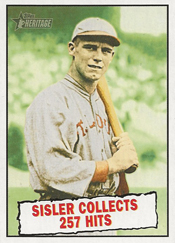
_ Wielding a 42-ounce bat, Sisler totaled 257 hits in 1920. Only Ichiro Suzuki (262 in 2004) produced more.
_ Batting .340 for his career and totaling 2,812 hits. Sisler likely would have achieved 3,000 if he didn’t sit out the 1923 season because of a sinus infection that caused double vision.
_ Batting .337, with 60 hits, against Walter Johnson.
_ Four times leading the American League in stolen bases.
Ty Cobb called Sisler “the nearest thing to a perfect ballplayer,” according to the Baseball Hall of Fame.
Sisler pitched in 24 games in the majors and was 5-6 with a 2.35 ERA. Cobb went 0-for-6 against him. In 111 innings, Sisler never allowed a home run.